
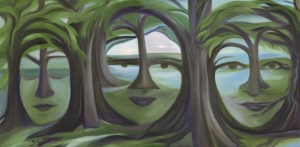
“Facing the Edge of the Forest – The Awakening” by Susan Cohen Thompson.
We envision a flourishing world
Our vision is to contribute to a eudaimonic, flourishing world by developing new pathways for cultural and systemic change — grounded in the conviction that worldviews are a critical, yet largely unaddressed, leverage point for transformation.
The crisis of our time
Our world faces interconnected crises — from climate breakdown and ecological collapse to democratic backsliding, societal polarisation, and a widespread crisis of meaning and mental health. These crises are not separate.
They feed on one another: when people lose touch with a sense of meaning and belonging, they struggle to connect with others. When relationships erode, trust collapses — between people, and in the institutions that serve them. When institutions lose legitimacy, they can no longer mobilise effective responses to the challenges we face. And when collective action fails, individuals are left even more isolated and disoriented.
At the root of this vicious cycle lie our worldviews — the deep frameworks of meaning, values, and assumptions through which we interpret reality. Worldviews shape what we consider true, valuable, and possible. They inform how we relate to ourselves, to others, to the natural world, and to the future. They are, in many ways, the invisible architecture of our crises — and a deep leverage point for addressing them.
Why current approaches fail
Most efforts to “change hearts and minds” rely on one of two approaches, both of which have proven inadequate.
The information approach assumes that people will update their beliefs when given better facts. But information lands in existing webs of meaning — worldviews — that filter, distort, or reject what threatens identity. This is why decades of climate communication, for example, have failed to produce the shifts in behaviour and policy we urgently need. The problem is not a lack of information; it’s that information alone cannot change the lenses through which it is interpreted.
The prescription approach tries to change culture by telling people what to think and believe — and shaming or excluding those who don’t comply. While well-intentioned, this approach has produced significant backlash, alienating the very people it needs to reach and deepening the polarisation it seeks to overcome. Prescription fails because humans resist being programmed. We are meaning-making beings, not machines to be updated.
Neither approach has an adequate theory of how worldviews actually shift. Read more on World/views: To Change the Culture, Change the Conversation.
A different pathway for creative change
We believe a fundamentally different approach is needed — one grounded in a richer understanding of human nature. Humans are not blank slates to be programmed with the right beliefs, nor rational actors who simply need better data. We are beings with latent capacities — for self-reflection, perspective-taking, moral discernment, and purpose — that can be cultivated through the right conditions, but cannot be prescribed.
This insight changes everything about how we approach change-work. The question shifts from “How do we get people to think the right things?” to “How do we create conditions under which people can access their own depths, encounter difference without defensiveness, and grow?”
Generative dialogue can create conducive conditions for this. It is not debate, nor “being nice”, but the structured practice of thinking-in-relationship — organizing conversations such that they generate trust, insight, and perspective shifts. When the conditions are right, dialogue softens defences, enables self-reflection, and allows worldviews to update from within rather than being attacked from without.
What changes when we get this right
When people engage in generative dialogue, three things tend to happen:
- Relationships are rebuilt. Deep listening and authentic exchange create trust and connection — even across significant differences. This begins to repair the social fabric that polarisation has torn.
- Human democratic capabilities are cultivated. Dialogue trains capacities like self-reflection, listening, perspective-taking, and collaborative sense-making. These are not skills that can be taught through instruction alone; they must be practised. Our Human Democratic Capabilities Meta-Map offers a framework for understanding what these capabilities are and how they relate to one another.
- Worldviews gradually widen. By creating safety and connection first, dialogue enables people to examine their own assumptions and entertain other perspectives without feeling threatened. Over time, this tends to widen worldviews — not through imposition, but through the natural process of human growth when the conditions support it.
Together, these shifts can begin to reverse the vicious cycle of our time — turning alienation into connection, disconnection into trust, and paralysis into purposeful action.
The education our time demands
Realizing this vision requires a different kind of education — one that goes beyond knowledge transmission and cognitive skill development. We need an education that:
- Addresses our worldviews and supports people to become aware of the lenses through which they see, rather than remaining blind to them;
- Fosters wise and mature humans, not just knowledgeable experts — cultivating the inner capacities needed to navigate complexity, hold tension, and act with integrity;
- Supports people in how to think well, not what to think — creating conditions for growth rather than prescribing conclusions, in a spirit that is fundamentally democratic and non-indoctrinatory;
- Encourages people to widen their circles of care and compassion, cultivating a sense of belonging to the larger whole — the communities, ecosystems, and planet we are part of;
- Uses dialogue as a core pedagogy, recognising that transformation happens in relationship, not in isolation.
As sustainability education professor Stephen Sterling put it: “Transformative learning invites the experience of seeing our worldview rather than seeing with our worldview, so that we can be more open to and draw upon other views and possibilities.”
This is the education Worldview Journeys is working to develop and scale — through the Worldview Journey program, the Generative Dialogue Lab at Utrecht University, our Facilitator Training, and our growing body of academic research.
Our theory of change, in a nutshell
We cannot change worldviews through information or prescription. But we can create conditions — through generative dialogue, transformative learning, and worldview exploration — under which people naturally grow: rebuilding relationships, cultivating democratic capabilities, and gradually widening the lenses through which they see and shape the world. As we change the conversation, we change the culture. And as we change the culture, we change our world.
Seeing the lenses that shape our world to change our world.